Will AI Replace the Electrician? The Future of Electrical Construction
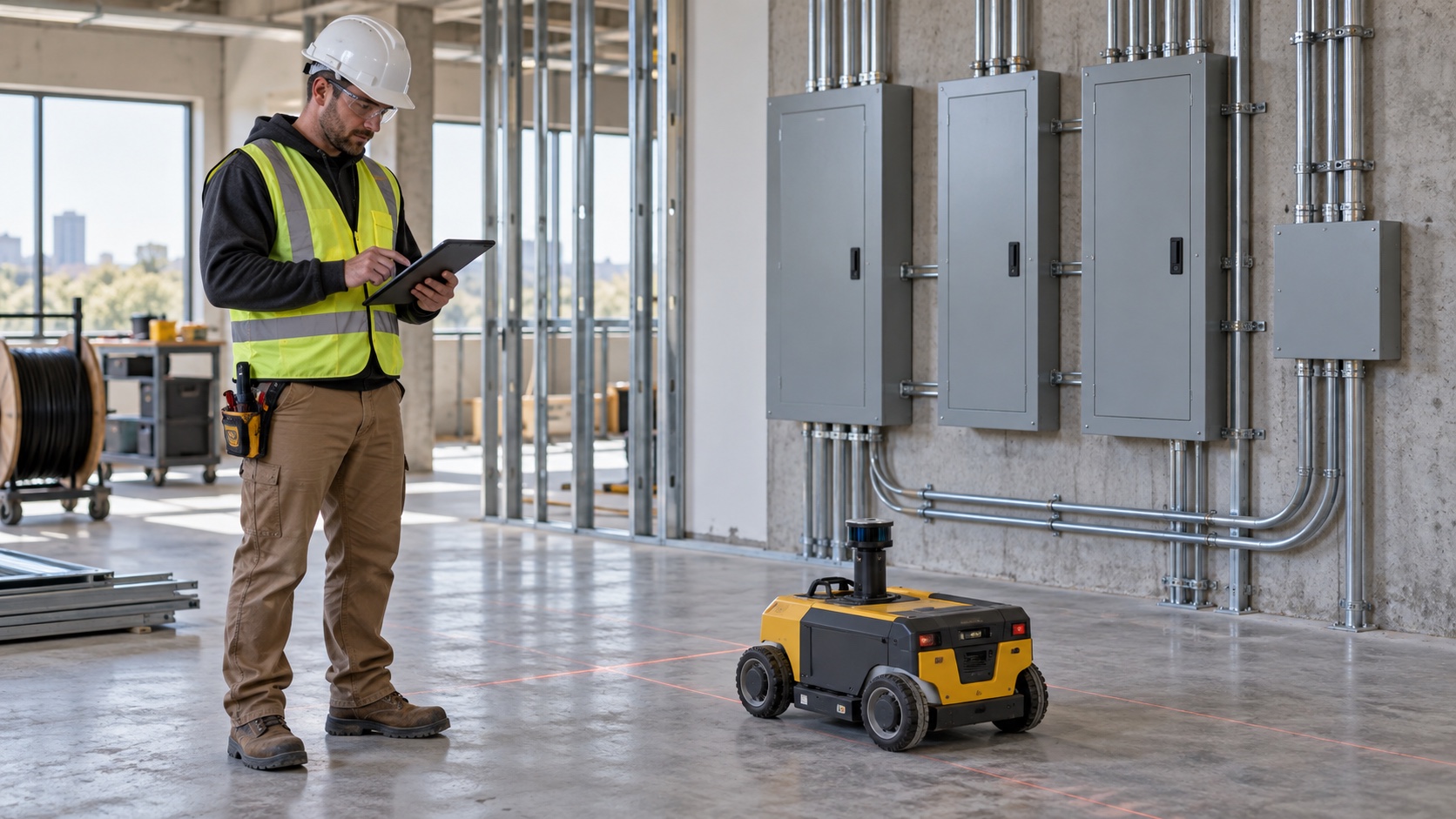
Featured image: AI-generated concept illustration of an electrician and a robotic layout tool; not an actual XDS crew, project, or product demonstration.
AI is changing electrical construction. But replacing a task is not the same as replacing an electrician.
A robot that drills ceiling anchors is real. Software that helps search specifications is real. Machines that cut, strip, and label wires are real. None of those examples, by itself, establishes that a machine can take responsibility for an unfamiliar building's electrical work from start to finish.
Our assessment: AI and robotics are more likely to reshape the electrician's job in the near term than eliminate it. That does not mean every task, position, or business model stays the same. It means we need to separate what the technology can demonstrate today from what somebody hopes to sell tomorrow.
Research reviewed September 28, 2026. Product descriptions below are attributed to their manufacturers; forecasts are not guarantees. These examples do not mean XDS Electric owns or uses the named systems.
First, Separate AI From Automation
These terms often get lumped together. Software AI can summarize information, recognize patterns, or flag items for review. Robotics adds physical movement. Conventional automation can repeat a programmed process without a conversational AI model at all.
That distinction matters. A machine preparing a batch of wires in a controlled shop faces a different problem from a technician troubleshooting an intermittent fault in an occupied apartment. Both belong to electrical work, but they are not interchangeable jobs.
What Is Already Happening?
1. Digital Plans Are Reaching the Jobsite Through Robots
Hilti describes its Jaibot as a semi-automated system that marks and drills overhead holes from digital plans for mechanical, electrical, and plumbing installations. Workers still handle setup and operation. This targets a repetitive, physically demanding part of installation—not the entire electrical scope. Source: Hilti Jaibot.
Dusty Robotics' FieldPrinter transfers digital layout information onto a building's floor. For an electrical crew, accurate coordinated layout can be valuable before installation starts. But a printed location does not independently prove that the design is correct or that a concealed condition matches the model. Source: Dusty Robotics.
2. Some Wire Preparation Is Already Automated
Rittal's Wire Terminal WT C5 processes specified wires through cutting, stripping, crimping, and labeling. This is a concrete example of automation taking over production steps in a controlled setting. It is not a machine that walks into an existing home and replaces its wiring. Source: Rittal.
Our expectation is that repeatable shop work and well-coordinated new construction will generally be easier starting points for automation than unpredictable service calls. That is an assessment of the work conditions, not a promise about any particular contractor's return on investment.
3. Software Is Taking On More Document Work
Autodesk describes AI features for specification searches and summaries, drawing-data extraction, photo tagging, takeoff symbol detection, and prioritizing project risks. These are practical ways to help a team find information and focus its review. They do not make the software the final authority on a drawing, a bid, or a safety decision. Source: Autodesk's construction AI overview.
The useful workflow is simple: let the system find or organize information, then have a responsible person check it against the actual project documents and field conditions.
4. Robots Can Help Document Progress
Boston Dynamics describes Turner Construction using Spot with a camera and DroneDeploy to capture repeatable walkthroughs on large construction projects. That provides a record people can review. It is not the same as a permit inspection, electrical testing, or proof that every concealed connection is correct. Source: Boston Dynamics' Turner case study.
For owners, the distinction is important: better pictures can improve visibility, but a progress image and a verified electrical result are different kinds of evidence.
What About Humanoid Robots That Can Handle Wires?
It would be a mistake to dismiss physical AI as nothing more than a video trick. In June 2026, Figure reported a Figure 03 demonstration at BMW involving parts handling and moving a cart in a manufacturing logistics workflow. That is meaningful progress—but it is not an electrical-service deployment. Source: Figure, June 30, 2026.
Research is also moving closer to electrical assembly. A 2025 paper by Kienle and colleagues studied robotic connector mating using visual information, touch-related sensing, and force control, with experimental validation on an automotive center-console assembly task. The researchers describe wire-harness installation as a difficult manipulation problem. Their work is evidence of progress on a bounded task, not proof of autonomous building wiring. Source: connector-mating research, revised June 2025.
The fair question is not whether a robot can perform one impressive movement. It is whether it can perform the complete job reliably, recognize exceptions, stop safely, recover from failure, and do so at a cost that makes sense.
Why the Whole Job Is Harder to Replace
The Bureau of Labor Statistics describes electricians' work as a combination of installation, testing, troubleshooting, repair, reading plans, and following applicable regulations. It also notes that maintaining existing buildings can involve equipment that is difficult to access. Source: BLS Occupational Outlook Handbook.
Consider a hypothetical apartment renovation: the drawing is incomplete, the panel labeling is unreliable, the wall contains an unexpected obstruction, and the resident needs a clear explanation of the outage. Solving that job requires more than recognizing an object in a photograph.
Someone still has to determine what information can be trusted, what needs testing, when the plan must change, and when work must stop. A useful AI recommendation is an input to that process—not evidence that the work has been safely completed.
There are safety boundaries, too. OSHA's construction rules require employers to determine whether work could bring people, tools, or machines into contact with energized circuits and provide protection. Adding automation does not remove that responsibility. Source: OSHA 1926.416.
The Risk Is Not Just a Robot Making a Mistake
A confident software answer can be wrong. NIST identifies this risk in generative AI, including false statements and misleading reasoning or citations. In electrical work, an answer that sounds professional is not enough. Project documents, equipment instructions, the applicable code, and field verification still matter. Source: NIST's Generative AI Profile.
Robots introduce their own hazards. OSHA highlights risks during setup, programming, maintenance, and other non-routine operations. A tool that reduces repetitive strain can still require guarding, training, and a job-specific risk assessment. Source: OSHA robotics overview.
Our recommendation is to judge a system by its verified performance and failure handling—not simply by how impressive its best demonstration looks. Customer plans, interior photographs, and access information also need appropriate privacy controls before being shared with an AI service.
Will There Still Be Work for Electricians?
The current BLS outlook projects U.S. electrician employment to grow 9% from 2025 to 2035, with about 72,700 openings annually on average. Many openings are replacements for people retiring or leaving the occupation; they are not all newly created positions. This is a national projection, not a guarantee of local hiring or proof that automation will leave every worker unaffected. Source: BLS.
There is another side to the AI story: it needs electricity. The IEA's 2026 outlook projects global data-center electricity consumption to rise from 485 TWh in 2025 to about 950 TWh in 2030. Those figures cover data centers overall, not AI alone. The agency also identifies supply-chain, grid, and financing constraints. Source: IEA, Key Questions on Energy and AI.
That suggests potential demand for electrical infrastructure, but it does not translate directly into a predictable number of electrician jobs. Where projects are built, whether they proceed, and how much work is prefabricated all matter.
What Could Change Next?
Our outlook is conditional, not a countdown to replacement:
- Near term: more assistance with documents, estimating, layout, repetitive shop preparation, and progress records.
- As systems improve: broader robotic handling and assembly where access, parts, and work sequences can be controlled.
- Still unresolved: dependable, economical end-to-end electrical service across unfamiliar occupied buildings and unexpected conditions.
Some tasks may require fewer labor hours. Some companies may change crew sizes or move more work into shops. New demand and new technical roles may offset some of that change, but no responsible forecast can promise the same outcome for everyone.
What Should Crews and Customers Do With This?
For apprentices and experienced electricians, our advice is to build both kinds of skill: understand the electrical work deeply, and learn the digital tools that help document, plan, and verify it. Troubleshooting, clear communication, and recognizing an unsafe or incorrect result remain worth developing. Learning software should add to supervised trade training, not replace it.
For property owners, ask practical questions:
- Who checks the software's recommendation against this property's actual conditions?
- Who is responsible for testing, documentation, and correction work?
- What happens when the robot or software encounters something it cannot handle?
- How are your building records and photographs protected?
- Are claimed time savings demonstrated on comparable work, including setup and rework?
So, Will AI Replace the Electrician?
It can replace parts of the work. The evidence reviewed here does not establish that it can replace the full electrician's role across real-world construction and service work.
The direction worth pursuing is better tools, less avoidable strain, clearer records, and stronger verification. The standard should not change: the work has to be right, and someone has to be accountable for it.
Planning an electrical repair, renovation, or upgrade in the Kansas City area? Contact XDS Electric to discuss the actual scope and requirements of your project.
This article is an industry outlook, not electrical installation instructions or a guarantee about future employment. Manufacturer examples illustrate specific capabilities; they are not product endorsements.